How I'd Fix the World Cup Group Stage: Eight Groups of Six and Why Every Game Would Matter
In my big World Cup write-up I said the 48-team format was better than I expected, but that the problems people predicted still showed up, mostly around third place. This is where I actually lay out how I’d fix it. There’s even a simulator you can play with, built as part of the Worth the 90 project.
The short version: keep 48 teams, but restructure the group stage so qualification is harder, dead rubbers mostly disappear, and strong teams have to play each other early.
The structure
- 48 teams, split into 8 groups of 6.
- Three pots of 16 by FIFA ranking: Pot A (1 to 16), Pot B (17 to 32), Pot C (33 to 48). Every group gets two teams from each pot.
- Even though there are six teams in a group, you still only play three games, one against a team from each pot. So a Pot A side plays the other Pot A team, one of the two Pot B teams, and one of the two Pot C teams.
- After three games the six teams go into one table. First place goes straight to the last 16. Second and third go into a playoff round for the remaining knockout spots. Fourth, fifth and sixth are out.
So only 24 of 48 teams survive the group, instead of 32. Half the field goes home immediately. And it’s only about eight fewer games than the current 104, so you’re barely cutting anything, you’re just adding tension.
The full breakdown, including how the playoff round and the knockout bracket are seeded, is in the simulator: Alternative World Cup Format Simulator.
Why I think it works
Third place stops being a waiting game. The single worst thing about the current format is teams finishing their group early and then sitting around for a week to find out whether a result somewhere else sends them home. Here, qualification is settled inside your own group. Top three, you’re through. Fourth or lower, you’re out. You know your fate the moment your group finishes.
Strong teams have to play each other. Because every group has two Pot A teams and they’re guaranteed to meet, you get a genuine heavyweight fixture in every single group. No more top seeds tiptoeing through a soft group and only running into a real side in the last 16.
First place is worth fighting for. Winning the group skips the playoff entirely. Second and third still survive but have to win an extra knockout to reach the last 16. That gap between first and second is huge, which means nobody can afford to coast, and it becomes genuinely hard to guarantee top spot.
Smaller teams get a real route. Because you also play a team from your own pot, a lower-ranked side isn’t just queuing up to be beaten by giants. It has winnable games against teams at its own level where it can actually rack up points and climb the table. That makes their games matter instead of being formalities.
Put all of that together and basically every game in the group carries weight. That’s the whole point.
The one big drawback
I’m not going to pretend it’s perfect. The real problem is the last round of group games.
With eight groups, to keep it fair the final games in each group should kick off simultaneously, the way the current format does it on the last matchday. That means up to three games at the same time. It doesn’t reduce the number of games, but it does mean more of them clash, and I can see why that annoys fans who then have to split their attention.
But honestly? I love that. The final Champions League group-stage night, where the broadcast bounces between grounds and you’re tracking permutations across six games at once, is one of the best nights of the season for a football fan. Imagine eight of those, spread across three or four days of a World Cup. That’s not a bug to me, that’s a highlight.
What it would have looked like
Rather than a couple of hand-picked groups, I went further this time and rebuilt the whole thing: eight groups of six, seeded the way I described above. I tried to keep the groups as close as possible to the real ones from this World Cup, and simulated results based on the actual results those teams got so far: replicated the result if the match actually happened, or judged it based on their performance at the tournament. So what follows isn’t a cherry-picked example, it’s roughly how the whole tournament would have played out under this format.
The groups
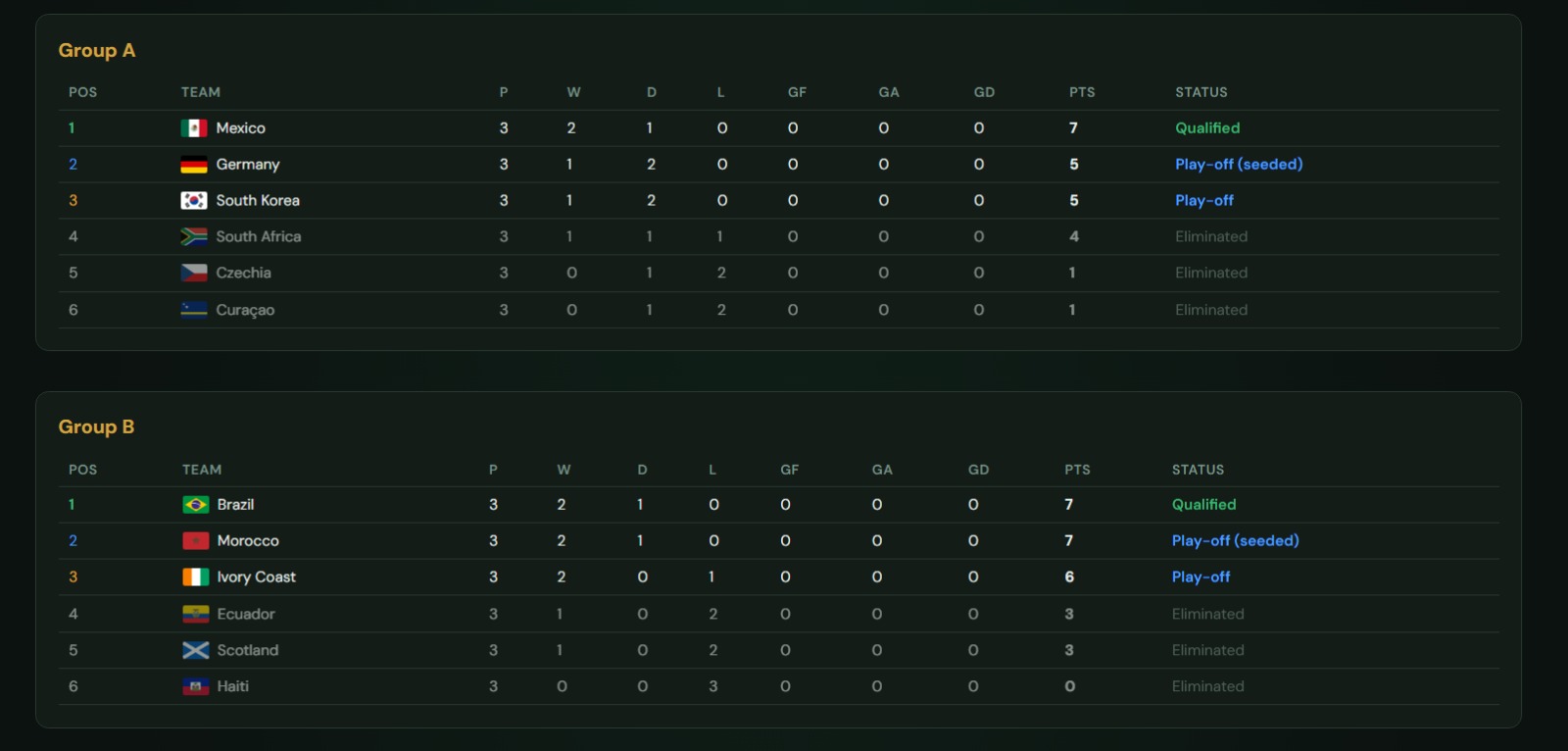
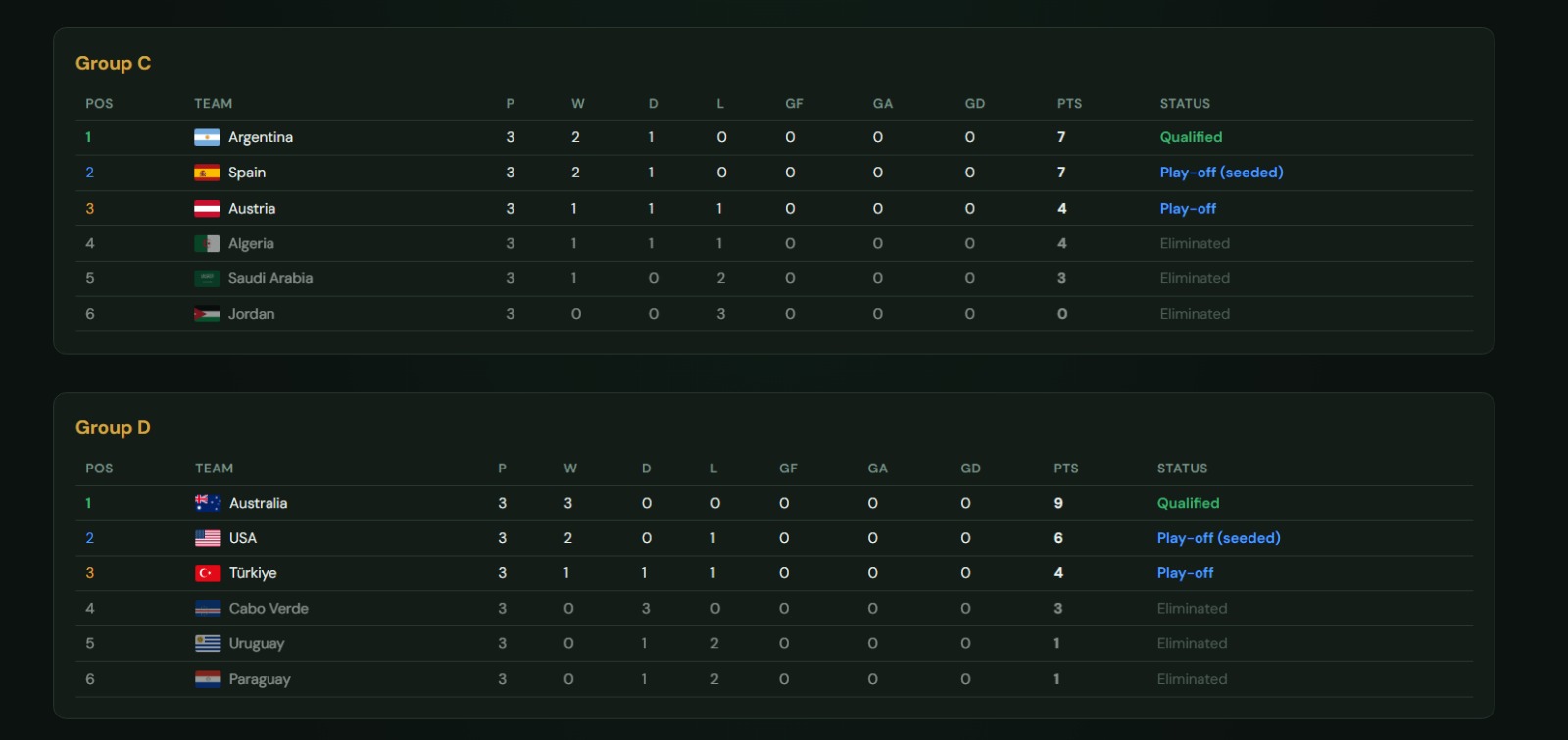
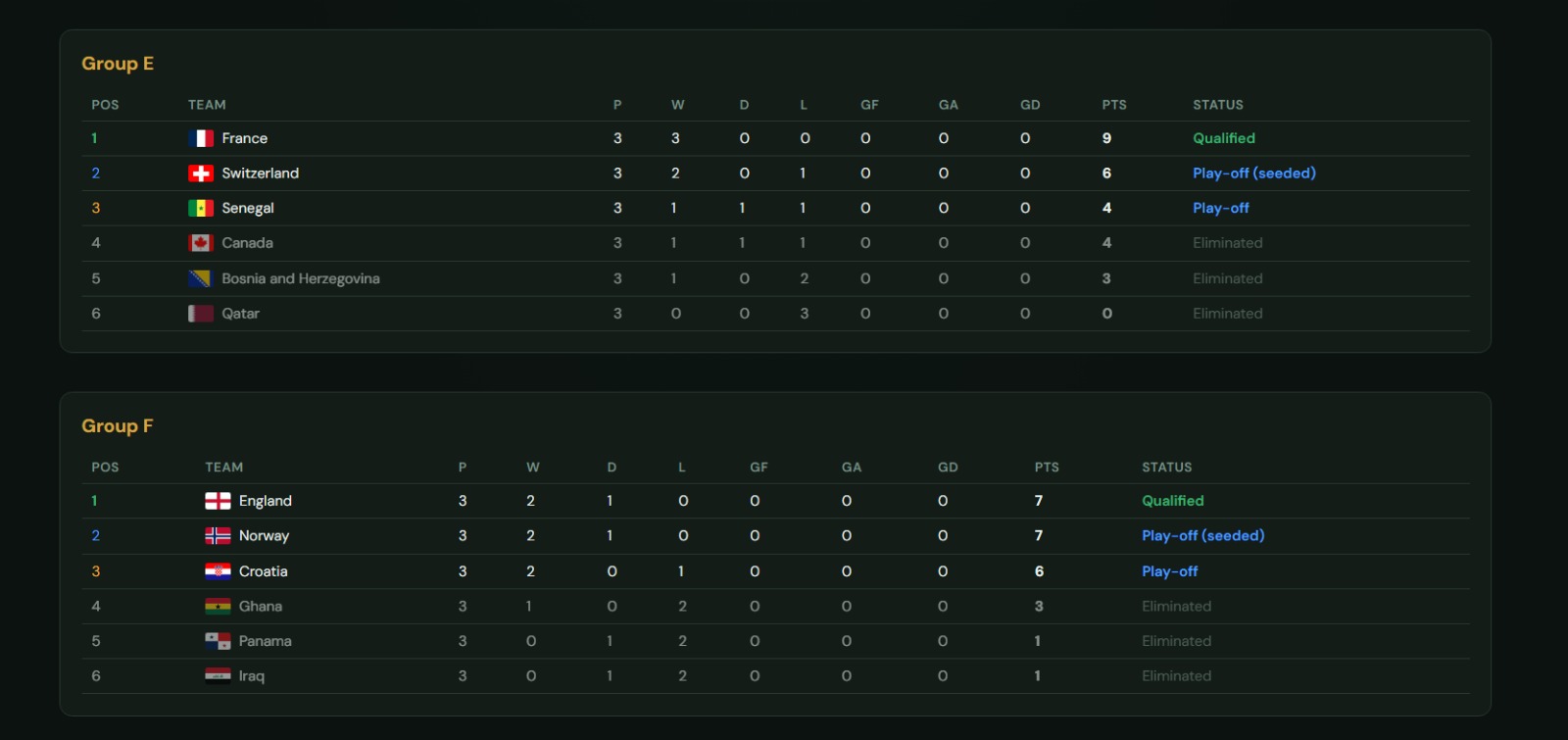
Same pattern every time: three points splits qualified, seeded playoff spot and unseeded playoff spot, and the bottom half of the group, including some decent sides, goes straight home.
The knockout stage
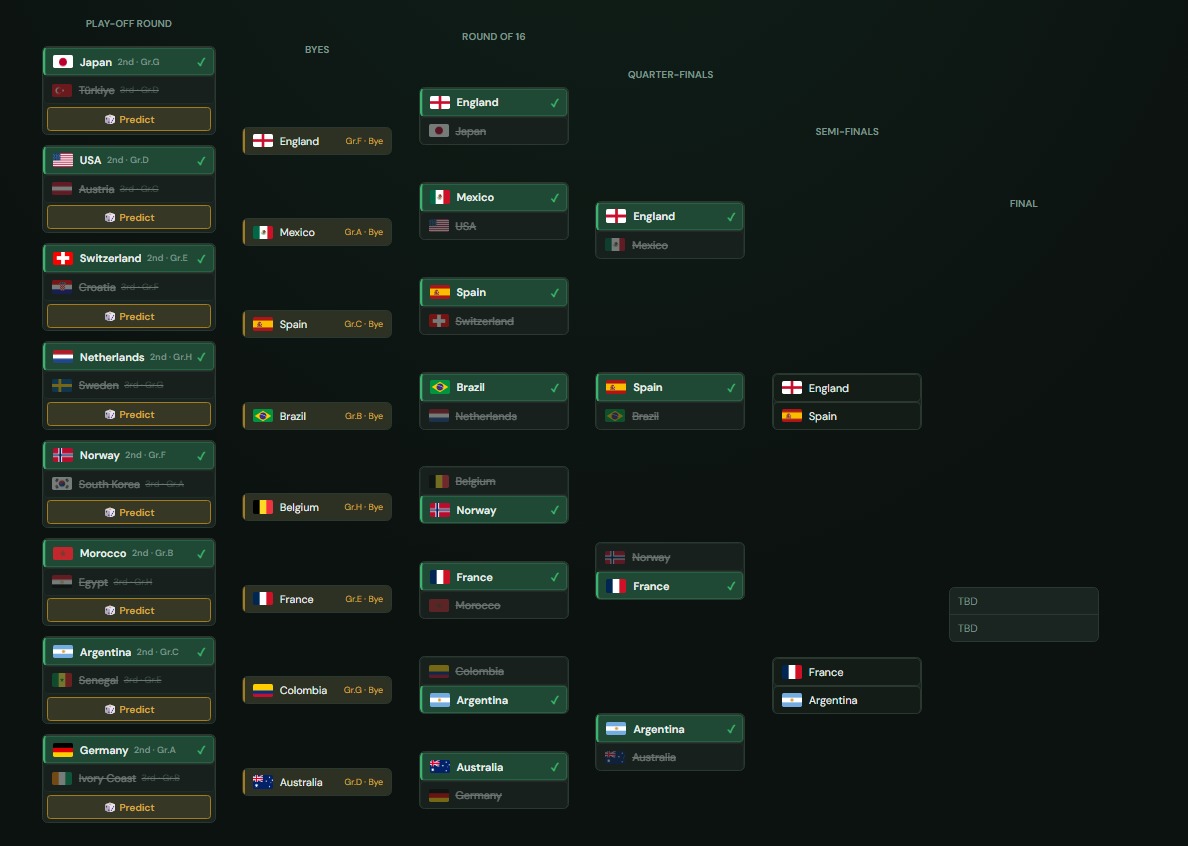
Eight group winners go straight to the last 16: England, Mexico, Spain, Brazil, Belgium, France, Colombia and Australia (they got some luck with the games they were drew to play). The sixteen second and third place teams play off for the other eight last-16 spots. In this simulation, Japan, USA, Switzerland, Netherlands, Norway, Morocco, Argentina and Germany all come through their play-offs.
From there: England beat Japan, Mexico beat USA, Spain beat Switzerland and Brazil beat Netherlands to reach the quarter-finals. On the other side, Norway upset Belgium, France beat Morocco, Argentina beat Colombia and Australia beat Germany.
The quarter-finals go England beating Mexico, Spain beating Brazil, France beating Norway and Argentina beating Australia. That sets up England against Spain and France against Argentina in the semi-finals, which I didn’t simulate as these ended up being the pre-tournament big favorites and actual semi-finalists.
I think overall it would’ve been a significant improvement over the actual tournament, with similar matchups, but with more decisive matches given the less forgiving group stage format.
Have a go yourself
That’s the case for it. Rather than take my word, you can build your own groups and run the whole thing in the simulator: Alternative World Cup Format Simulator. It’s part of the Worth the 90 project, which also scores every match for how good it actually was, spoiler-free: Worth the 90.